Warmest Winter in U.S. History So Far
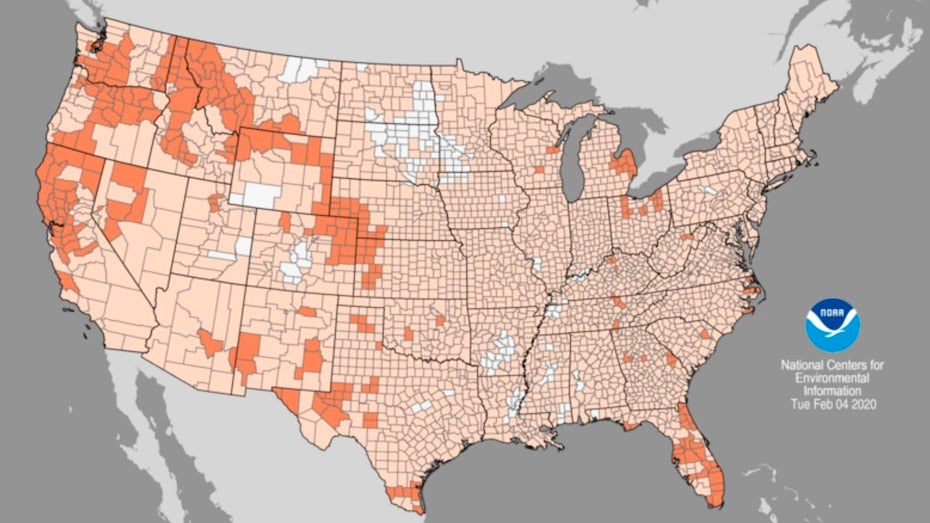
Above: County-by-county temperature rankings for the contiguous U.S. for the period November 2019 through January 2020. Out of the 3134 counties and county equivalents (such as parishs) in the Lower 48 states, not a single one had a temperature significantly below the 20th-century average for the three-month period. The vast majority of counties came in well above average. (NOAA/NCEI)
The first two months of meteorological winter (December 2019 – January 2020) were the warmest on record for the contiguous U.S. in data going back to 1895. NOAA provided the January data and images on Thursday ahead of its monthly U.S. climate report.
The average national temperature for the first two of winter’s three months was 35.95°F, topping the 35.82°F observed in Dec. 2005 – Jan. 2006.
Across the contiguous U.S., this winter so far is running about 4.5°F warmer than the average winter of the 20th century.
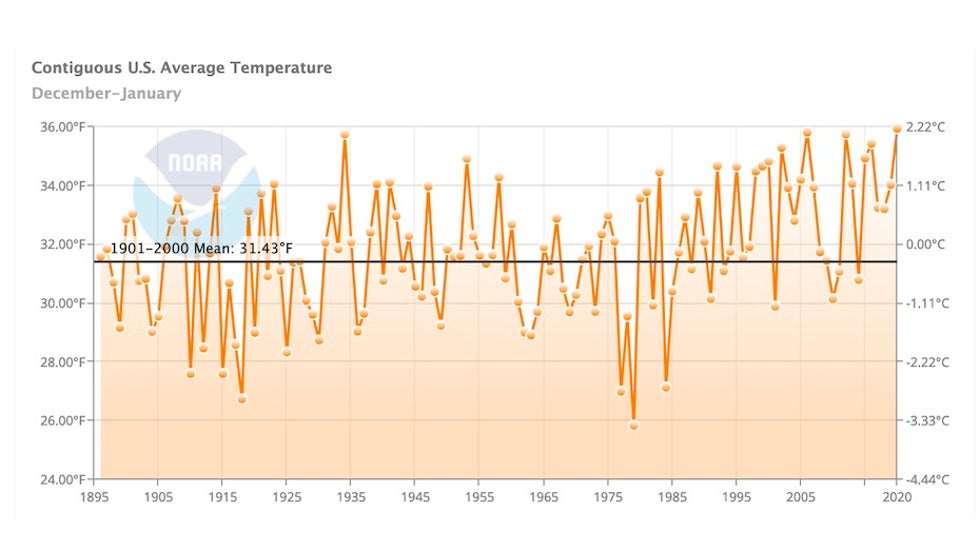
The nation saw its fifth warmest January on record, following the sixth warmest December.
Even though neither month was record-warm on a national or state level, the mild conditions were prolonged enough to top the national list when the two months are combined.
The warmth was also usually widespread. Not a single one of the Lower 48 states had a temperature significantly below average in December, and the same was true in January. Thirteen states had a top-ten-warmest January, including every New England state except Vermont.
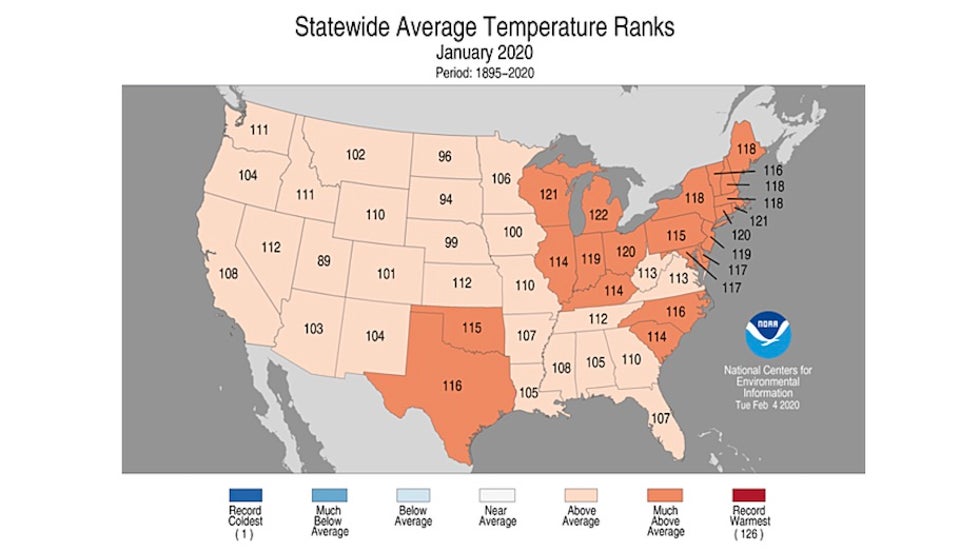
Interestingly, no single state made it into their top-three-warmest in either December or January—further evidence that what’s made this winter so exceptional isn’t the intensity of the mildness, but rather how widespread and sustained it’s been.
Although February has gotten off to an exceptionally mild start, colder-than-usual weather will dominate the western U.S. over the next few days. That may be enough to keep the full winter (December-February) from setting a warmth record, although we still have more than three weeks to go.
Another wetter-than-average month
While the phenomenal wetness of late 2019 into mid-2020 has backed off just a bit, last month was still the 26th wettest January on record. It was especially moist in Washington (fourth wettest) and across the southern and central Plains (sixth wettest in Oklahoma, tenth wettest in Missouri).
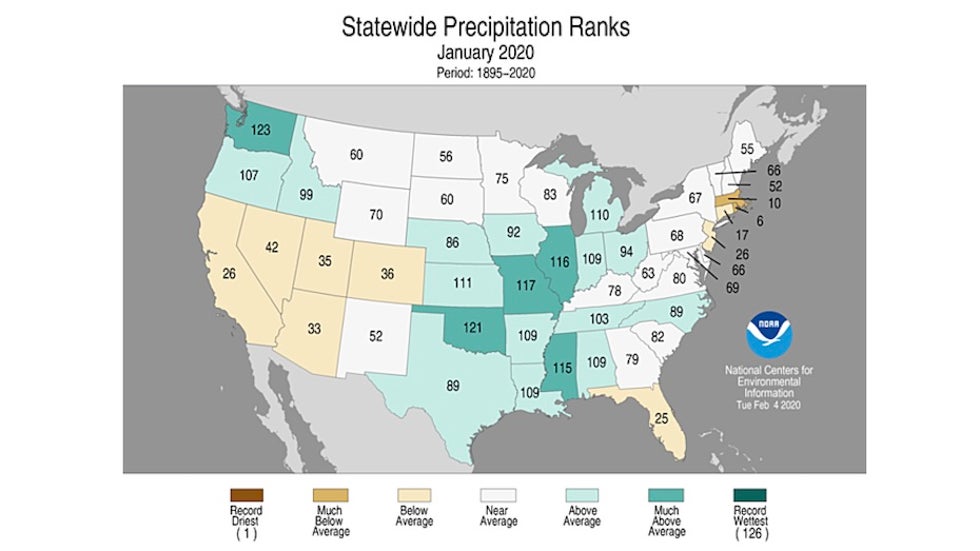
January was yet another month of above-average precipitation for the Midwest, where ample snowpack atop frozen, saturated ground is setting the stage for what could be another rough spring of river flooding. The North Central River Forecast Center will issue its first spring flood outlook of the year on Thursday, February 13.
Some of the most concerning floodways are the Red River of the North bordering North Dakota and Minnesota; the James River in eastern South Dakota; and the upper and mid-Missisissipi River.
As of Thursday, 65 U.S. locations have a better-than-even chance of major flooding between February and April, according to long-range simulations from the NOAA/NWS Advanced Hydrologic Prediction Service. The simulations are based on ensemble streamflow forecasts that incorporate a variety of possible weather conditions from late winter into spring.
The Weather Company’s primary journalistic mission is to report on breaking weather news, the environment and the importance of science to our lives. This story does not necessarily represent the position of our parent company, IBM.