First Half of 2017 Hottest on Record for Parts of U.S. Sunbelt

Above: A child drinks from a reusable water bottle amid a heatwave in Los Angeles, California, on June 26, 2017. Several heat records were set a day earlier. Image credit: Frederic J. Brown/AFP/Getty Images.
From the deserts of Arizona to the swamps of the Chesapeake, 2017 has already been a memorably scorching year—and it’s only half over. The first six months of 2017 were the second warmest on record for the contiguous U.S. (behind only 2012) in observations going back to 1895, according to NOAA’s national climate summary for June. The nation is well synched with the planet as a whole, which has been running second only to 2016 for its warmest year on record.
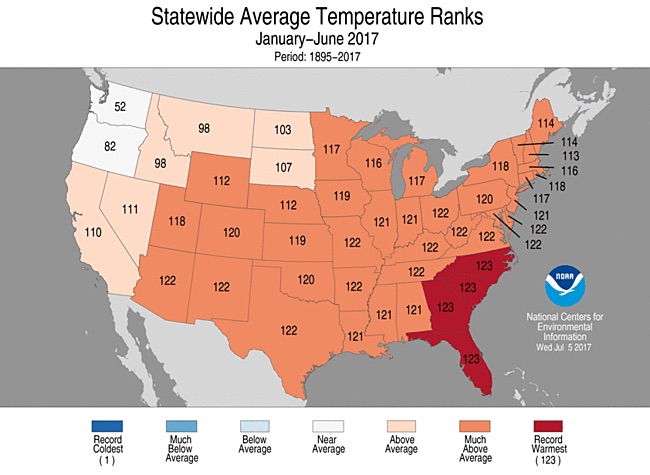
Four states sweated through their all-time warmest January-to-June period: North and South Carolina, Georgia, and Florida. Every one of the contiguous U.S. states has experienced a top-twelve-warmest year thus far, except for an eight-state arc running from California to the Dakotas.
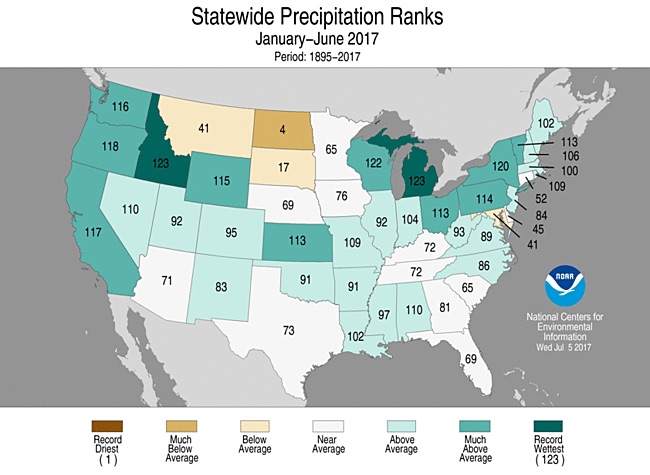
It’s also been a wet year so far when averaged across the nation, although the picture is more complex than that statistic might imply. The six-month average for the contiguous U.S. of 17.86” is the sixth wettest on record, at 2.55” above the long-term norm. It’s been the wettest year to date on record for Idaho and Michigan.
The remaining hydrologic wealth has been fairly well distributed except for the northern Plains, where crucial spring and early summer moisture has been largely absent. North Dakota is having its fourth-most-parched year on record, its driest since the horrific Dust Bowl year of 1936. An expanding area of extreme drought—almost twice as large as it was just a week ago—now runs from northeast Montana into northern South Dakota, according to Thursday’s weekly installment of the U.S. Drought Monitor. Some crops have already failed in North Dakota, the monitor reported.

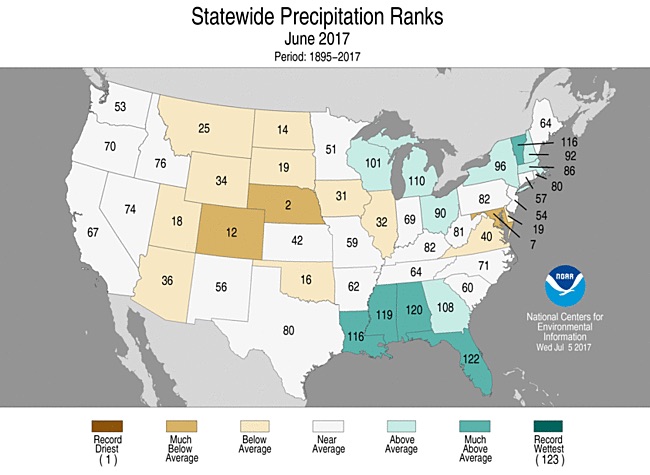
June did more than its part to push the central and northern Great Plains into drought. Precipitation was below average throughout the western half of the nation, and Nebraska had its second driest June on record. Precipitation was also scarce over the mid-Atlantic, where Maryland notched its seventh driest June. Not too far away, though, Vermont had its eighth wettest June, and it was a fairly wet month from New England to the Great Lakes. It was also very moist across the Deep South, where Louisiana, Mississippi, Alabama, and Florida all had top-ten-wettest Junes (thanks in part to Tropical Storm Cindy). As a whole, the contiguous U.S. ended up with its 68th wettest June, just a shade above average.
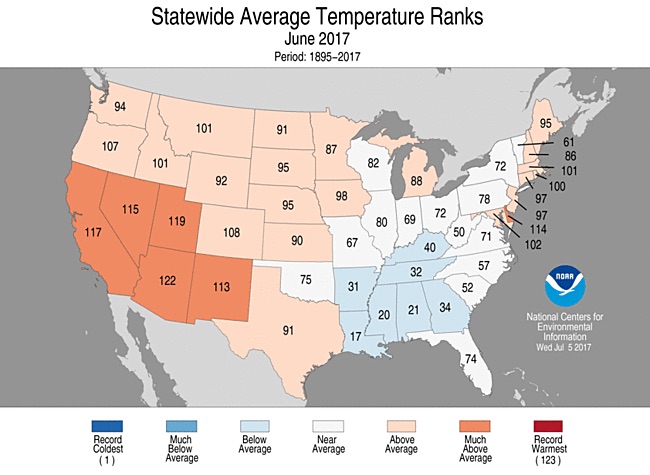
A historic heat wave that peaked just before the summer solstice (a few days earlier than usual for such events) blowtorched the Southwest U.S. with some of its highest temperatures and most intense multiday hot spells on record. Arizona saw its second-hottest June on record—which is saying something!—while every surrounding state had a top-ten-hottest June. Meanwhile, clouds and rain across the central Gulf states helped keep readings milder than average, especially during the heat of the day. Average daily highs in Louisiana were the second coolest on record for June. For the contiguous U.S. as a whole, last month tied as the 20th warmest June in 123 years of recordkeeping.
The Weather Company’s primary journalistic mission is to report on breaking weather news, the environment and the importance of science to our lives. This story does not necessarily represent the position of our parent company, IBM.