The Weirdly Quiet Sun May Get Even Quieter (and BTW, Earth Is Still Warming)

Above: A solar flare and coronal mass ejection during the ascending phase of the current solar cycle ejected huge amounts of hot plasma from the sun in mid-2012. As it fell back to the solar surface along twisted magnetic field lines, the plasma produced giant streaming arcs, some as tall as five Earths stacked high. An ultra high-definition telescope aboard NASA's Solar Dynamics Observatory (SDO) captured images of the display on July 19, 2012. Image credit: NASA Visualization Explorer.
After the most tepid solar cycle in at least a century, several top forecasters are now predicting an even more lackluster cycle in the 2020s. The sun’s prolonged calmness is fascinating as well as mysterious, but here’s something to keep in mind: even if the sun goes into a multi-decade “grand minimum”, any climate effects are likely to be swamped by human-produced climate change.
Starting in March, a panel of experts being convened by NOAA’s Space Weather Prediction Center (SWPC) and NASA will work on a consensus forecast to be issued later this year for Solar Cycle 25, the one that will unfold in the 2020s. A formal call for predictions to feed into the consensus report was issued in December.
Each solar cycle lasts about 10 to 12 years. Sunspot activity and other solar disturbances are greatly enhanced during the several years around each cycle’s peak, and global temperatures tend to be about 0.4°F (0.2°C) warmer around solar maximum versus solar minimum.
Cycle 24, which had a double peak in 2011 and 2014, is now close to the end of its lifespan. In fact, February 2019 was the first month since August 2008 without a single sunspot observed, as reported by spaceweather.com. The peak monthly average sunspot number during the cycle now ending was the lowest in 210 years, according to data at spaceweatherlive.com. When the sunspot numbers are averaged more broadly, across rolling 13-month periods, Cycle 24’s peak still ranks as the weakest since Cycle 14, which peaked in 1906. (These assessments are based on a recently revised version of the sunspot-number dataset.)


The total energy put out by the sun varies by only about 0.1% from the minimum to the maximum of each cycle. Much more significant is the change in ultraviolet output. It’s the energy at the very low wavelengths of the extreme ultraviolet range—which can vary by a factor or 10 or more—that drives “space weather” on Earth. During solar storms, bursts of magnetized material race toward Earth and interact with our outer atmosphere. Solar storms can knock out power grids and communication links, and by heating the upper atmosphere, they can increase atmospheric drag on satellites and pull them off course.
Predicting the next cycle
A growing cadre of scientists is taking on the challenge of predicting the strength and duration of upcoming solar cycles. Since 2013, dozens of predictions for Cycle 25 have been published in peer-reviewed journals, according to Lisa Upton (National Center for Atmospheric Research).
Upton, who is co-chairing the NOAA-based Solar Cycle 25 Prediction Panel with SWPC’s Doug Biesecker, has already provided her own take. In a 2018 paper published in Geophysical Research Letters, Upton and David Hathaway (Stanford University) predict that the next cycle will be slightly weaker than Cycle 24, which itself was the weakest in more than 100 years. Weak cycles tend to be preceded by prolonged solar minima; along these lines, Upton and Hathaway expect that Cycle 24 may not bottom out until 2021. The Earth-facing side of the sun was free of sunspots on more than 200 days in 2018, and we can expect many dozens more sunspot-free days over the next year or two, as is typically the case during solar minima.

A journey toward the solar equator
There’s increasing convergence on the idea that the sun’s magnetic fields—and the prominences, flares, coronal mass ejections, and other disturbances they generate—work their way from the poles toward the equator during a solar cycle. In this conceptual model, each new cycle emerges at the sun’s higher latitudes (around 55°N and 55°S) and ends when the fields in each hemisphere—which have opposite polarities—reach the equator. At this point, the fields cancel, somewhat abruptly, in a process that solar physicists Scott McIntosh (National Center for Atmospheric Research) and Robert Leamon (University of Maryland) have labeled the “terminator", or “the event that marks the hand-over from one sunspot cycle to the next."
A number of forecasters now keep a close eye on the magnetic fields at high solar latitudes, especially as these fields evolve during the sun’s quiet phase. When the fields are especially strong at high latitudes, they appear to herald an active cycle ahead. Weaker fields portend a less energetic cycle. Since these fields precede the solar maximum by several years, this approach to prediction has been dubbed the polar field precursor method—one of several techniques that look for precursors of the next solar cycle.
On top of this, solar scientists are creating surface flux transport (SFT) models that can track the evolution of the sun’s magnetic fields over time. Such models could potentially give several years’ notice of the strength of polar fields expected at high latitudes during solar minimum. Upton and Hathaway developed one such SFT model for their forecasting effort. Their August paper included data only up to January 2018, but Upton says the magnetic fields since then are behaving as they expected: “Our results seem to be in very good agreement with the observations.”

Not all forecasters agree that Cycle 25 will be even weaker than Cycle 24. Some statistical techniques are leaning toward a more robust cycle in the 2020s. A group headed by Volkan Sarp (Akdeniz University, Turkey), which uses a nonlinear extrapolation technique, predicted in a 2018 paper that Cycle 25 will be around 33% stronger than Cycle 24, though still weaker than the prior several cycles. Similarly, Kejun Li (Yunnan Observatories, China) and colleagues are predicting a Cycle 25 that will be stronger than Cycle 24 but weaker than the preceding cycle.
The longer-term outlook: Are we headed for a grand minimum—and would that counterbalance global warming?
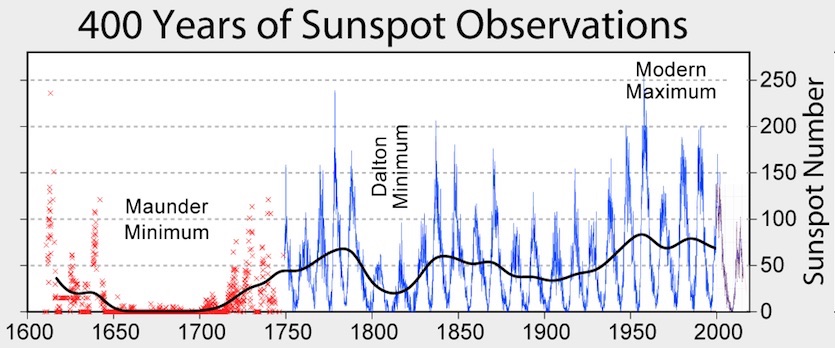
Observers have been tracking sunspots for many centuries with the naked eye. Systemic telescope observations of sunspots started at the Paris Observatory in the 1600s, and the Zurich Observatory launched the first daily observations in 1749. A few periods in this long record stand out as unusually quiet.
- Solar activity appears to wax and wane over a period of 90 to 100 years in a mode called the centennial Gleissberg cycle. The quiet Solar Cycle 14 at the start of the 20th century was part of a Gleissberg minimum, just as the now-ending Solar Cycle 24 appears to be.
- A more pronounced dip in solar activity, centered on the period from 1800 to 1820 and coinciding with the quiet part of the Gleissberg cycle, is known as the Dalton minimum.
- The Maunder minimum, a time of exceptionally quiet solar activity, spanned the period from around 1645 to 1715. During the 28-year heart of the Maunder minimum, fewer than 50 sunspots were recorded, compared to the 10,000 or more per decade observed today.
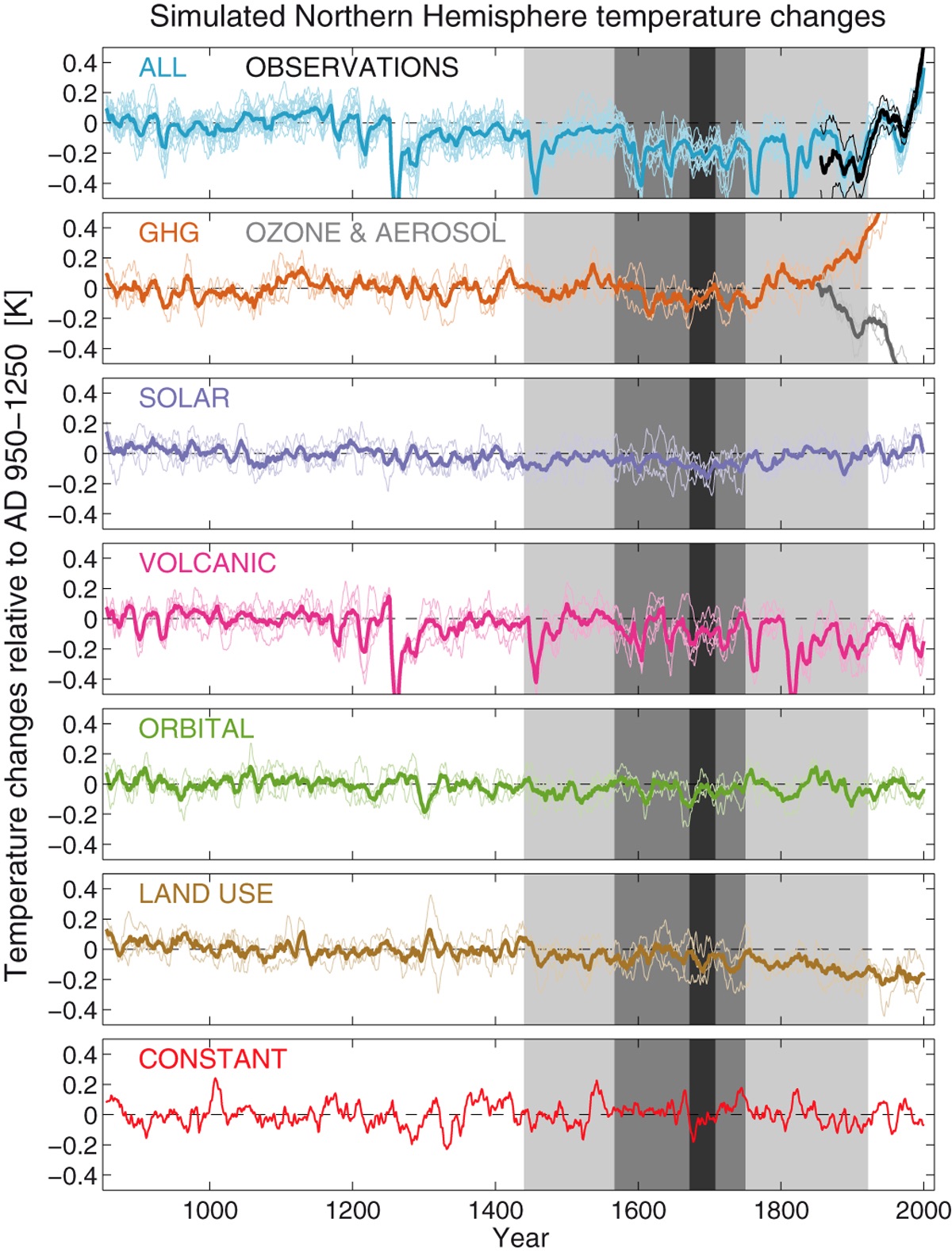
The planet was indeed chilly during the Maunder minimum, with surface temperatures in the Northern Hemisphere about 0.9°F (0.5°C) below their 1961-1990 average. However, the drop in solar input is unlikely to have been the prime cause of the cooling, since the most prolonged cold period of the Little Ice Age (from 1570 to 1750) got under way more than 70 years before the Maunder minimum. Sun-blocking volcanic eruptions are believed to be one of the main drivers of the Little Ice Age.
It’s also possible that reforestation after big drops in agriculture—e.g., after the Black Plague in Europe and following the first wave of colonization in the Americas—pulled enough carbon dioxide from the air to account for some of the cooling.

Mathew Owens (University of Reading) recently led an international team that reviewed connections between the Maunder minimum and the Little Ice Age. Their work was published in 2017 in an open-access paper in the Journal of Space Weather and Space Climatology. In an email, Owens explained:
“Often in studies of long-term solar variability or solar cycle prediction, I see throw-away comments along the lines of ‘...and this is important for climate, as the Maunder minimum caused the Little Ice Age.’ They're usually unreferenced, as this seems to be almost accepted wisdom in some corners of solar physics. I wanted something in a space physics journal which cleared up this misconception in an accessible way, if only to make my life easier!”
After reviewing a large number of studies, Owens and colleagues concluded that “many different factors probably caused the cooler temperatures during the [Little Ice Age] periods and no one factor alone is responsible. Overall, it is likely that the effect of volcanic eruptions was the largest influence, followed by the drop in solar activity and changes in land use.”
As for more recent times, the Intergovernmental Panel on Climate Change estimated in its Fifth Assessment Report that the slight increase in overall solar activity from 1870 to 2010 added somewhere between 0.02°C and 0.1°C to the global warming of nearly 1°C observed during that period.
What next?
The dynamics that drive longer-scale solar behavior remain shrouded in mystery, so it’s impossible at this point to predict solar cycles beyond the 2020s with much confidence. According to Upton and Hathaway, “it is too early to determine if this will remain a short Gleissberg minimum (like the Dalton) or if the Sun will produce a longer grand minimum (like the Maunder).”
What we do know is that even the cooling of a multi-decade grand minimum, which could approach a few tenths of a degree Celsius, would be hard-pressed to compete with the increasing impact of human-produced greenhouse gases in warming Earth’s climate.
A 2010 study by Georg Fuelner and Stefan Rahmstorf assumes that solar energy would drop during a grand minimum by about 0.25% from its 1950 value, which is comparable to estimates of the reduced solar input during the Maunder minimum. Fuelner and Rahmstorf found that the reduced solar energy would only trim at the very most about 0.9°F (0.5°C) from 21st-century warming, and probably quite a bit less than that. This pales in comparision to the 21st-century warming of 4.7° to 8.6°F (2.6°C – 4.8°C) projected in IPCC’s highest-end scenario (RCP8.5).
A 2013 study by Gerald Meehl, Julie Arblaster, and Daniel Marsh (NCAR) came up with similar results for a 0.25% drop in solar energy across a 40-year span. They used a global model (WACCM) that extended up into the stratosphere; this allowed for ozone chemistry and stratospheric dynamics to be included, expanding the potential ways in which a drop in solar energy could influence the projected climate. Even so, global warming was dented by only about 0.27°F (0.16°C) during the modeled 40-year grand minimum. Afterward, it only took about 30 years for global temperature to reach the same level through human-induced warming that it would have reached had the grand minimum not slowed things down.
Cosmic rays and global warming
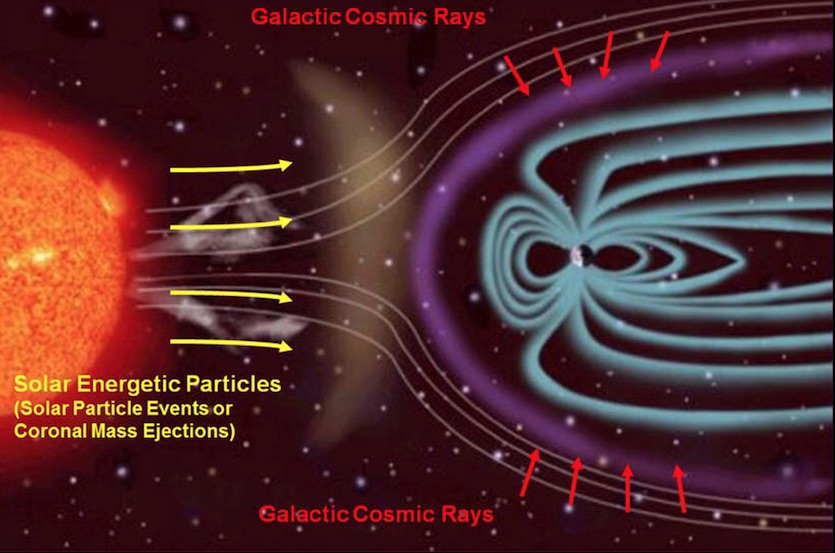
Although research suggests that long-term shifts in total solar energy have only a modest direct effect on global temperature, the idea of a more powerful indirect effect has drawn some ardent supporters. This viewpoint, based largely on work by Henrik Svensmark (Technical University of Denmark), hinges on the fact that a quiet sun would allow more cosmic rays to reach Earth’s atmosphere, as depicted in Figure 8. There is some laboratory evidence that cosmic rays support the development of cloud droplets by ionizing potential nuclei, as discussed in a 2017 paper by Svensmark and colleagues in Nature Communications. If that’s the case, so the argument goes, then a quiet sun should lead to cooling on Earth because the increased cosmic rays would generate more cloudiness and result in more reflection of sunlight to space.
There are big questions around whether this hypothesized chain of events could come to pass in the real world. For one thing, the ionization effects on cloud nuclei are difficult to replicate outside the laboratory, as noted by researcher Terry Sloan (University of Lancaster) in Cosmos magazine. Sloan and other experts assert that cloud nuclei such as dust are so prevalent that any cloud-forming boost from cosmic rays would be at the margins.
Someone who’s long been familiar with the cosmic ray hypothesis is John Cook (George Mason University), the creator of skepticalscience.com and one of the world’s leading researchers on public knowledge and attitudes around climate change. Among the many common and not-so-common questions addressed at skepticalscience.com is "Are we heading into a new Ice Age?”. According to Cook:
“Svensmark's cosmic ray hypothesis is more an intellectual curiosity than having any real consequence for the climate debate. Even if he was right and there was a mechanism for cosmic rays to influence climate through cloud formation (that's a big if), the trend in cosmic radiation is going in the wrong direction. In other words, if cosmic radiation did affect climate change, it should be imposing a cooling effect right now - implying that human activity has an even greater warming effect than currently understood.”
Indeed, even with the sun at its quietest in more than a century during the 2010s, the last five years (2014-2018) have been the warmest globally in records going back to the late 1800s. It’s a striking juxtaposition as we continue hurtling into what many are calling the Anthropocene epoch—a time in which humans are having far-reaching impacts on the natural world.
For more on the connections between the 11-year solar cycle and Earth's atmosphere, see our post from January 18, "Church of Sol: The Solar Cycle's Potential Impact on Weather and Climate."
The Weather Company’s primary journalistic mission is to report on breaking weather news, the environment and the importance of science to our lives. This story does not necessarily represent the position of our parent company, IBM.