U.S. Tornado Power Has Increased by More Than a Factor of Two Since 1994

Above: A tornado rips across a Colorado field in April of 2016. Image credit: wunderphotographer adkinsadam1.
The number of strong (EF2 and EF3) and violent (EF4 and EF5) tornadoes in the U.S. has remained roughly constant in recent decades. However, tornadoes have been coming in bigger bunches with individual tornadoes being wider and staying on the ground longer, resulting in an increase in the destructive power of U.S. tornadoes averaging 5.5% per year since 1994, said Dr. James Elsner of Florida State University in a talk on Wednesday at the annual meeting of the American Geophysical Union in Washington D.C. He cited longer tornado path lengths as being the key reason for the observed increase in tornado power.
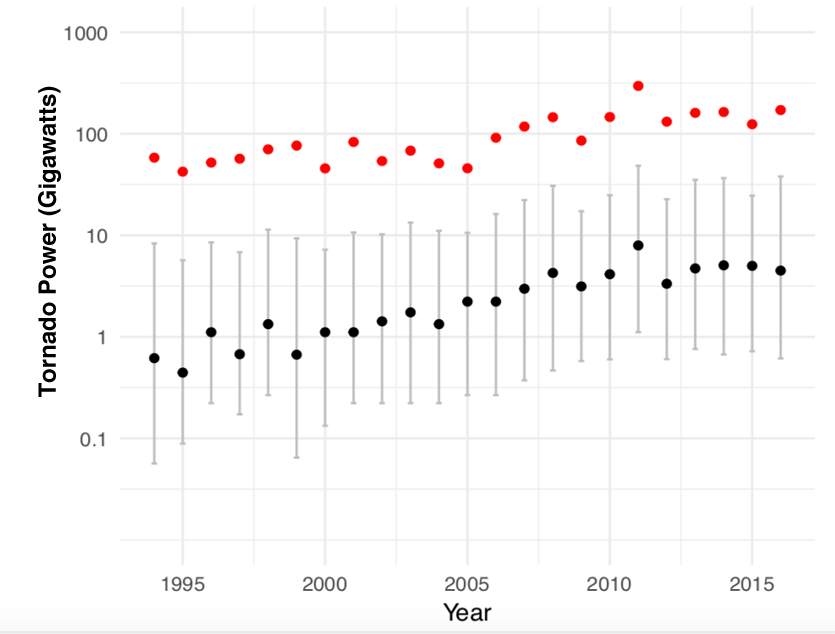
Using the database of U.S. tornadoes between 1994 and 2016, Dr. Elsner computed the power of a tornado using the cube of the wind speed multiplied by the density of air times the area affected by the tornado, summed up along the entire path length. The power is strongly correlated to the amount of damage a tornado does. Corrections had to be made to the database for the switch-over from the F-scale rating system to the EF-scale in 2007, as well as for the diurnal cycle, season of the year, and natural climate variability (the El Niño-Southern Oscillation, or ENSO).
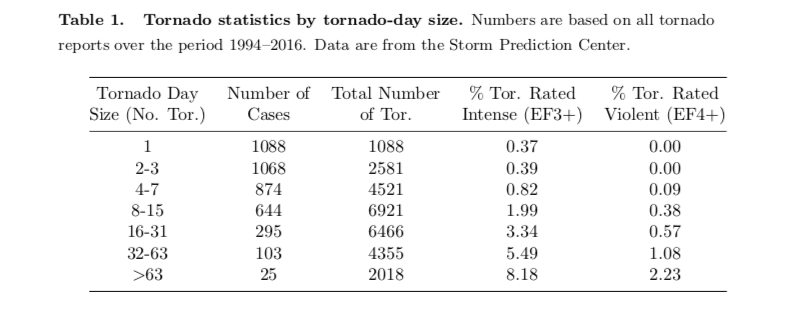
The observed increase in the number of days when big bunches of tornadoes occur in recent years implies a larger threat of damaging tornadoes, since the percentage of violent tornadoes (EF4 or worse) has been observed to increase in larger outbreak days. On days with 16 to 31 tornadoes, less than 4% of the tornadoes are rated EF3 or worse, while on days with more than 63 tornadoes, more than 8% of the tornadoes are rated EF3 or worse (Table 1). Increased percentages of violent (EF4 and EF5) tornadoes with increasing tornado-day size occur as well.
On average, tornadoes are more powerful at night, in cold months, and during La Niña
Elsner's study found that a given tornado is more likely to be strong or violent at night, between 10 pm – 4 am, and during the coldest months, between November and April. This counterintuitive result could be because there are fewer tornadoes overall at night and in winter, but tornadoes that do develop at these times are more likely to be in environments of strong wind shear, thus allowing their destructive power to be higher on average.
The cycle of alternating ocean-atmosphere conditions in the equatorial Pacific, known as the El Niño-Southern Oscillation (ENSO), has a significant influence on tornado power. During La Niña conditions, the average power of U.S. tornadoes was more than 40% higher than during El Niño conditions during the period 1994 - 2016.
Higher tornado power is to be expected during La Niña conditions (especially during winter), since more amplified upper-air troughs of low pressure tend to move across North America. This results in warmer than normal temperatures in the Southeast and cooler than normal temperatures in the Northwest, which sets the stage for severe weather outbreaks that are intensified by a strong jet stream.

Increasing atmospheric instability may be the cause of the increase in tornado power
Tornadoes need two key ingredients to form: instability and wind shear. Instability is maximized when warm, moist air lies near the surface with cold, dry air aloft. This situation gives storms a high level of instability--with the technical term being convective available potential energy (CAPE). The scientists theorized that the observed increase in tornado power was due to long-term increases in CAPE—something that climate models predict should happen as a result of global warming.
The other key ingredient needed for strong tornadoes—high wind shear (a sharp change in winds, which gets the tornado spinning)—is predicted to decrease in the future, according to climate model projections. However, higher wind shear has been observed in many of the more recent large tornado outbreaks, and the increase in CAPE in this environment of higher wind shear has been responsible for the increase in tornado power, according to Elsner's work.
While it is currently not possible to blame the observed increase in tornado power on global warming, it is concerning that we are seeing more powerful tornadoes occurring when climate models give us a potential reason (an increase in CAPE) to suspect that climate change might be the cause.
High confidence in the results
Dr. Elsner is the best statistician I know working in the atmospheric sciences. After the talk, I asked him how confident he was of the results given the uncertainties in the tornado database and the fact that a tornado has to run over a building to get an EF rating (and many tornadoes do not). He replied: “Compared to the HURDAT hurricane database, which I’ve worked with for several decades, the tornado database is in much better shape. I’m confident that the increase in tornado power that we’ve found is real.”
“Increasingly Powerful Tornadoes in the United States”, by James Elsner, Tyler Fricker, and Zoe Schroder was published last week in Geophysical Research Letters. A preliminary version is available for free online.
Related posts
Tornadoes and Climate Change: Huge Dangers, Huge Unknowns, my 2013 post.
weather.com has a video explaining the results of Dr. Elsner's paper.
Bob Henson contributed to this post.
The Weather Company’s primary journalistic mission is to report on breaking weather news, the environment and the importance of science to our lives. This story does not necessarily represent the position of our parent company, IBM.