June 2018: Earth's 5th Warmest June on Record

Above: The deadliest disaster of June 2018 was flooding in China’s Yangtze River valley that has claimed 108 lives since May. This photo taken on June 24, 2018, shows cars swept away by a landslide in Tianlin county in China's southern Guangxi region. Image credit: AFP/Getty Images.
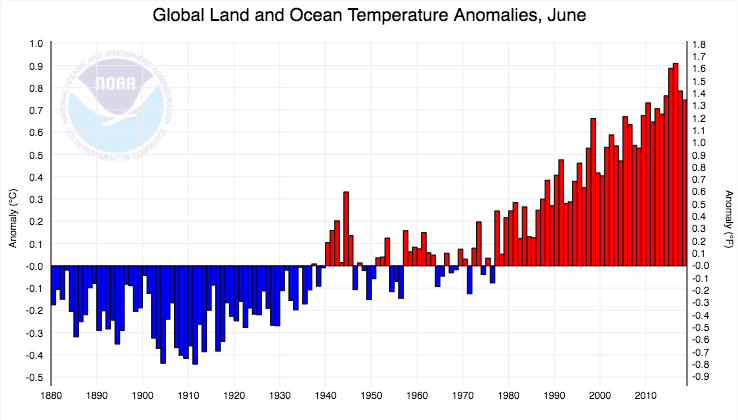
June 2018 was the planet's fifth-warmest June since record keeping began in 1880, said NOAA's National Centers for Environmental Information (NCEI) on Monday. NASA rated June 2018 as tied for third-warmest June on record. NOAA found that the only warmer June months were 2016, 2015, 2017 and 2014, in that order. Occasional differences in rankings between NASA and NOAA arise mostly due to how they handle data-sparse regions such as the Arctic, where few surface weather stations exist.
Global ocean temperatures during June 2018 were the sixth warmest on record, and global land temperatures were also the sixth warmest on record, according to NOAA. Global satellite-measured temperatures in June 2018 for the lowest 8 km of the atmosphere were the ninth or tenth warmest in the 40-year record, according to the University of Alabama Huntsville (UAH) and RSS, respectively.

Two billion-dollar weather disasters in June 2018
Two billion-dollar weather-related disasters hit the Earth last month, according to the June 2018 Catastrophe Report from insurance broker Aon Benfield: a severe weather outbreak in the U.S. that cost $1.4 billion, and flooding in China’s Yangtze River basin that has cost $1.3 billion since May. In addition, damage claims from a March severe weather outbreak in the U.S. topped the $1 billion mark by the end of June. Here is the list of the twelve billion-dollar weather disasters so far in 2018:
- Drought, Argentina and Uruguay, 1/1 – 3/31, $3.9 billion, 0 killed
- Winter Storm Riley, Eastern U.S., 3/1 – 3/3, $2.25 billion, 9 killed
- Winter Storm Friederike, Western & Central Europe, 1/18, $2.75 billion, 13 killed
- Winter Weather, China, 4/2 – 4/18, $1.5 billion, 0 killed
- Severe Weather, Rockies, Plains, Midwest, Northeast U.S., 6/17 – 6/20, $1.4 billion, 0 killed
- Severe Weather, Rockies, Plains, Midwest, Northeast U.S., 5/12 – 5/16, $1.4 billion, 0 killed
- Severe Weather, Plains, Southeast, Northeast U.S., 3/18 – 3/21, $1.35 billion, 0 killed
- Flooding, China, 5/1 – 6/30, $1.3 billion, 108 killed
- Winter Storms Eleanor & Carmen, Western & Central Europe, 1/1 – 1/4, $1.3 billion, 7 killed
- Drought, South Africa, 1/1 – 5/31, $1.2 billion, 0 killed
- Winter Storm Grayson, Central & Eastern U.S., 1/3 – 1/5, $1.1 billion, 22 killed
- Winter Weather, China, 1/24 – 1/29, $1.1 billion, 2 killed


El Niño conditions expected later this year
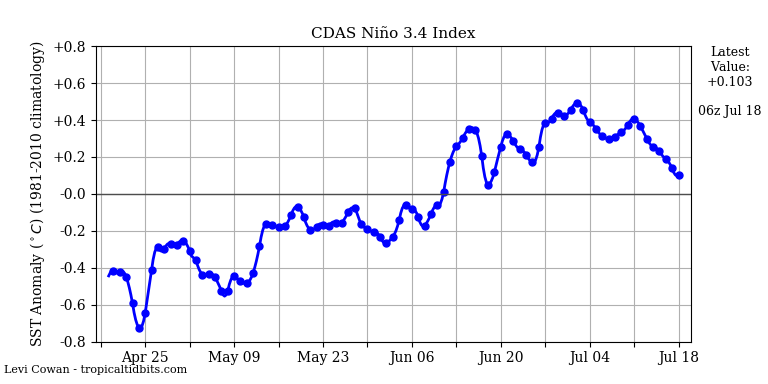
An El Niño Watch continues as sea surface temperatures (SSTs) in the eastern tropical Pacific Ocean approach the threshold for a weak El Niño, said NOAA’s Climate Prediction Center (CPC) in its July 12 monthly advisory. Over the past week, sea surface temperatures (SSTs) in the benchmark Niño 3.4 region (in the equatorial Pacific) were about 0.2°C above average, below the 0.5°C above-average threshold needed to be classified as a weak El Niño.
Odds for an El Niño event to form are predicted to increase through the end of 2018, with the July 12 CPC/IRI Probabilistic ENSO Forecast calling for a 57% chance of an El Niño event during the August-September-October peak of the Northern Hemisphere hurricane season. Those odds are up substantially from a 38% chance in the May CPC/IRI outlook. El Niño events typically reduce Atlantic hurricane activity, due to an increase in wind shear over the tropical Atlantic. The odds of El Niño are pegged at 70% for this coming winter (December-January-February), the time of year when El Niño events are typically at their strongest.
Arctic sea ice falls to 4th-lowest June extent on record
Arctic sea ice extent during June 2018 was the fourth lowest in the 40-year satellite record, according to the National Snow and Ice Data Center (NSIDC). The record-lowest June extent came in June 2016. Sea ice extent was near average around Antarctica.
Notable global heat and cold marks set for June 2018
Hottest temperature in the Northern Hemisphere: 52.5°C (126.5°F) at Dehram, Iran, 8 June
Coldest temperature in the Northern Hemisphere: -29.0°C (-20.2°F) at Geo Summit, Greenland, 28 June
Hottest temperature in the Southern Hemisphere: 37.6°C (99.7°F) at Palmas, Brazil, 3 June
Coldest temperature in the Southern Hemisphere: -77.1°C (-106.8°F) at Concordia, Antarctica, 30 June
(Courtesy of Maximiliano Herrera.)
Major weather stations that set (not tied) new all-time heat or cold records in June 2018
Glasgow (United Kingdom) max. 31.9°C, 28 June
Belfast Airport (United Kingdom) max. 29.5°C, 28 June
Eskdalemuir (United Kingdom) max. 29.9°C, 28 June
Shannon (Ireland) max. 32.0°C, 28 June
Castlederg (United Kingdom) max. 30.2°C, 29 June
(Courtesy of Maximiliano Herrera)
Three all-time national heat records broken in 2018
So far in 2018, three nations have broken an all-time record for its hottest temperature in recorded history: Palau, which hit 95°F (35°C) at Koror on June 22, Taiwan, which hit 104.5°F (40.3°C) at Tianxiang on July 10, and Algeria, which hit 124.3°F (51.3°C) at Ourgla on July 5. No nations have set an all-time cold temperature record so far in 2018. Most nations do not maintain official databases of extreme temperature records, so the national temperature records reported here are in many cases not official. I use as my source for international weather records researcher Maximiliano Herrera, one of the world's top climatologists, who maintains a comprehensive list of extreme temperature records for every nation in the world on his website. If you reproduce this list of extremes, please cite Maximiliano Herrera as the primary source of the weather records.
Twenty-two monthly national/territorial heat records so far in 2018
January: Marshall Islands
February: Marshall Islands, Falkland Islands, Kuwait, Qatar, Saudi Arabia, Palau.
March: Marshall Islands, Qatar, Armenia, Madagascar, Pakistan, Iraq, UAE, Turkmenistan, Tajikistan, Uzbekistan.
April: Albania, Montenegro
May: Hong Kong, Norway
June: Oman
(Courtesy of Maximiliano Herrera.)
National monthly cold records in 2018: none
No national monthly records for cold were set in June 2018.
Continental/Hemispheric records in 2018
Highest temperature ever recorded in April in Asia: 50.2°C (122.4°F) at Nawabshah, Pakistan, 30 April
World record of the highest reliably-measured minimum temperature in 24 hours: 42.6°C (108.7°F) at Qurayyat, Oman, 26 June
The Weather Company’s primary journalistic mission is to report on breaking weather news, the environment and the importance of science to our lives. This story does not necessarily represent the position of our parent company, IBM.