July 2018: Earth's 4th Warmest July on Record

Above: The deadliest disaster of July 2018 was flooding in Japan that claimed 230 lives. Seen here is an aerial view of flooded houses in Kurashiki, Okayama prefecture, Japan, on July 8, 2018. Image credit: STR/AFP/Getty Images.
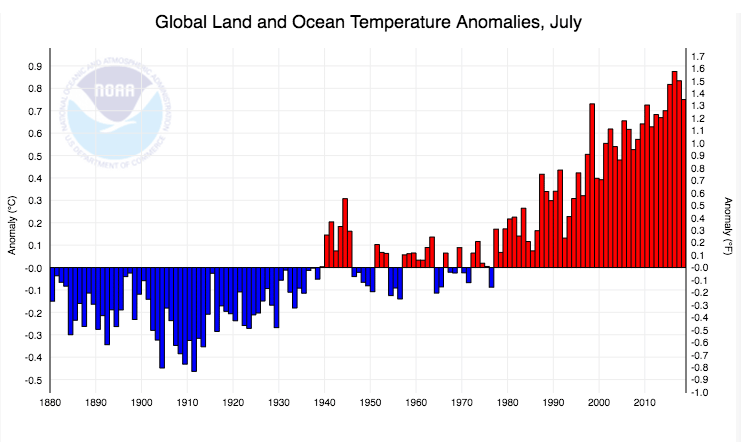
All-time record heat assaulted northern Europe, western Africa, portions of southern Asia, and California, helping make July 2018 the planet's fourth-warmest July since record keeping began in 1880, said NOAA's National Centers for Environmental Information (NCEI) on Monday. NASA rated July 2018 as the third-warmest July on record, with the only warmer July months coming in 2016 and 2017. Occasional differences in rankings between NASA and NOAA arise mostly due to how they handle data-sparse regions such as the Arctic, where few surface weather stations exist.
Global ocean temperatures during July 2018 were the sixth warmest on record, and global land temperatures were the fifth warmest on record, according to NOAA. Global satellite-measured temperatures in July 2018 for the lowest 8 km of the atmosphere were the fourth warmest in the 40-year record, according to the University of Alabama Huntsville (UAH) and RSS.
The year-to-date period of January – July now ranks as the fourth warmest on record, and it is increasingly likely that the five warmest years on record globally will be 2014 through 2018. If an El Niño develops later this year, as predicted, that will give 2019 a very good chance of joining the pack. Barring a massive volcanic eruption, global temperature seems to be headed in one direction, and it isn't downward.

Four billion-dollar weather disasters in July 2018
Four billion-dollar weather-related disasters hit the Earth last month, according to the July 2018 Catastrophe Report from insurance broker Aon Benfield: droughts in Europe and Australia that cost $4 billion and $1.2 billion respectively, along with a flood disaster in Japan that cost $1.2 billion, and a series of wildfires in California that cost $1 billion. In addition, damage claims from an April severe weather outbreak in the U.S. topped the $1 billion mark by the end of July, giving the planet seventeen billion-dollar weather disasters so far in 2018:
- Drought, Northern and Central Europe, 5/1 – 7/31, $4.0 billion, 0 killed
- Drought, Argentina and Uruguay, 1/1 – 3/31, $3.9 billion, 0 killed
- Winter Storm Riley, Eastern U.S., 3/1 – 3/3, $2.25 billion, 9 killed
- Winter Storm Friederike, Western & Central Europe, 1/18, $2.75 billion, 13 killed
- Flooding, Japan, 7/5 – 7/8, $2.0 billion, 229 killed
- Winter Weather, China, 4/2 – 4/18, $1.5 billion, 0 killed
- Severe Weather, Rockies, Plains, Midwest, Northeast U.S., 6/17 – 6/20, $1.4 billion, 0 killed
- Severe Weather, Rockies, Plains, Midwest, Northeast U.S., 5/12 – 5/16, $1.4 billion, 0 killed
- Severe Weather, Plains, Southeast, Northeast U.S., 3/18 – 3/21, $1.35 billion, 0 killed
- Flooding, China, 5/1 – 6/30, $1.3 billion, 108 killed
- Winter Storms Eleanor & Carmen, Western & Central Europe, 1/1 – 1/4, $1.3 billion, 7 killed
- Severe Weather, Plains, Midwest, Southeast, Northeast U.S., 4/13 – 4/17, $1.25 billion, 6 killed
- Drought, South Africa, 1/1 – 5/31, $1.2 billion, 0 killed
- Drought, Australia, 1/1 – 8/1, $1.2 billion, 0 killed
- Winter Storm Grayson, Central & Eastern U.S., 1/3 – 1/5, $1.1 billion, 22 killed
- Winter Weather, China, 1/24 – 1/29, $1.1 billion, 2 killed
- California wildfires, 7/24 – 8/1, $1 billion, 6 killed


El Niño conditions expected later this year
NOAA’s Climate Prediction Center (CPC) kept an El Niño Watch in place in its August 9 monthly advisory. Over the past week, sea surface temperatures (SSTs) in the benchmark Niño 3.4 region (in the equatorial Pacific) were about 0.2°C above average, still shy of the 0.5°C above-average threshold needed to be classified as a weak El Niño.
Odds for an El Niño event to form are predicted to increase through the end of 2018, with a 60% chance during the September – November period, and a 70% chance for the coming winter (December-January-February), the time of year when El Niño events are typically at their strongest. The August 9 CPC/IRI Probabilistic ENSO Forecast calls for a 62% chance of an El Niño event during the September-November period. El Niño events typically reduce Atlantic hurricane activity, due to an increase in wind shear over the tropical Atlantic.
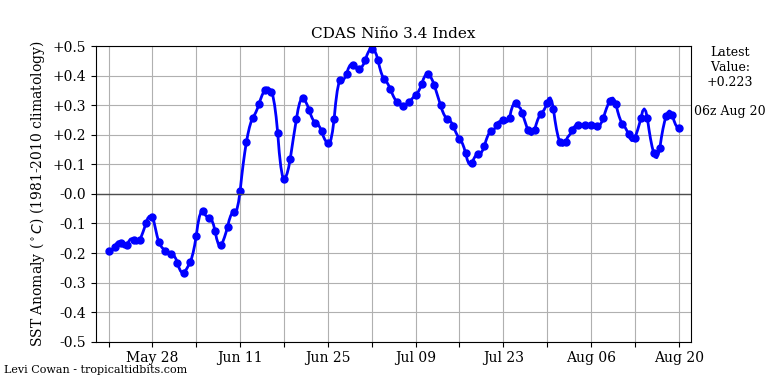
Figure 3. Sea surface temperatures (SSTs) in the benchmark Niño 3.4 region (in the equatorial Pacific) have been about 0.2°C above average over the past week, which qualifies as neutral conditions. Image credit: Levi Cowan, tropicaltidbits.com.
Arctic sea ice falls to 9th-lowest July extent on record
Arctic sea ice extent during July 2018 was the ninth lowest in the 40-year satellite record, according to the National Snow and Ice Data Center (NSIDC). Despite finishing ninth lowest in the monthly average, ice loss was rapid during the month, particularly during the last half of July—despite the persistence of low sea level pressure over the Arctic Ocean and generally cool conditions. As a result, by July 31 daily extent was the fourth lowest in the satellite record, just below the extent seen last year at this time, and also just above that seen in 2007, 2011, and 2012. The NSIDC 2018 projection for the sea ice minimum extent during the annual Septmber minimum falls between the fourth and ninth lowest in the 40-year satellite record.
Sea ice extent was near average around Antarctica.
Notable global heat and cold marks set for July 2018
Hottest temperature in the Northern Hemisphere: 53.0°C (127.4°F) at Ahvaz, Iran, 2 July
Coldest temperature in the Northern Hemisphere: -29.6°C (-21.3°F) at Geo Summit, Greenland, 21 July
Hottest temperature in the Southern Hemisphere: 38.3°C (100.9°F) at Conceicao do Araguaia, Brazil, 24 and 28 July
Coldest temperature in the Southern Hemisphere: -79.9°C (-111.8°F) at Vostok, Antarctica, 6 July
(Courtesy of Maximiliano Herrera.)
Major weather stations that set (not tied) new all-time heat or cold records in July 2018
An astonishing 228 major weather stations with a long period of record (POR) exceeding 40 years broke their all-time heat record in July. Japan had the most stations break their heat record, with 67, followed by Norway (50), South Korea (13), Finland (12), Algeria (11), Netherlands (10), Germany (9), Sweden (8), North Korea (8), U.S. (5), Turkmenistan (5), Tunisia (5), Belgium (4), Russia (4), Azerbaijan (1), Iraq (1), Kazakhstan (1), Georgia (1), Denmark (1), France (1), India (1), and United Arab Emirates (1). Two stations in Australia broke their all-time cold records. Below is the remarkable tally of new all-time records for stations with a 40+ year POR:
Baku (Azerbaijan) max. 42.7°C, 1 July
Turkmenbashi (Turkmenistan) max. 45.6°C, 1 July
Kocubej (Russia) max. 41.6°C, 1 July
Novyj Ushtogan (Kazakhstan) max. 44.8°C, 2 July
Salahaddin (Iraq) max. 41.8°C, 2 July
Montreal (Canada) max. 36.6°C, 2 July
Montreal Saint Hubert Airport (Canada) max. 36.2°C, 2 July
Bouarfa (Morocco) max. 43.4°C, 3 July
Beni Abbes (Algeria) max. 47.9°C, 3 July
El Golea (Algeria) max. 48.5°C, 4 July
Tbilisi (Georgia) max. 40.5°C, 4 July
Sognefjell (Norway) max. 20.6°C, 4 July
Ouargla (Algeria) max. 51.3°C, 5 July: New national record high for Algeria
Ghardaia (Algeria) max. 47.4°C, 5 July
Touggourt (Algeria) max. 49.5°C, 5 July
El Oued (Algeria) max. 49.7°C, 5 July
Tozeur (Tunisia) max. 49.2°C, 5 July
Thala (Tunisia) max. 41.4°C, 5 July
Santa Ana (California, USA) max. 45.6°C, 6 July
Ramona (California, USA) max. 47.2°C, 6 July
San Bernardino (California, USA) max. 47.8°C, 6 July
Burbank (California, USA) max. 45.6°C, 6 July
Tompo (Russia) max. 37.4°C, 8 July
Ust Charky (Russia) max. 36.1°C, 8 July
Krest Haldzhaj (Russia) max. 35.9°C, 9 July
Al Ain (United Arab Emirates) max. 49.7°C, 10 July
Tianxiang (Taiwan) max. 40.3°C, 10 July: New national record high for Taiwan
Yerevan (Armenia) max. 42.4°C, 12 July
Chardzhev (Turkmenistan) max. 45.0°C, 14 July
Kairouan (Tunisia) max. 48.3°C, 14 July
Sidi Bouzid (Tunisia) max. 46.7°C, 14 July
Gafsa (Tunisia) max. 46.5°C, 14 July
Tamworth (Australia) min. -8.6°C, 14 July
Parkes (Australia) min. -6.6°C, 15 July
Tashiro (Japan) max. 31.0°C, 15 July
Tohin (Japan) max. 33.6°C, 15 July
Kisohirasawa (Japan) max. 35.9°C, 15 July
Tsuchiyama (Japan) max. 37.2°C, 15 July
Ohuasa (Japan) max. 36.2°C, 15 July
Furyo (Japan) max. 33.9°C, 16 July
Otawara (Japan) max. 37.1°C, 16 July
Nikko (Japan) max. 30.4°C, 16 July
Ikuno (Japan) max. 37.5°C, 16 July
Miyoshi (Japan) max. 37.9°C, 16 July
Akana (Japan) max. 35.1°C, 16 July
Trondheim Airport (Norway) max. 32.4°C, 16 July
Snasa (Norway) max. 31.6°C, 16 July
Mo I Rana (Norway) max. 32.6°C, 17 July
Namsskogan (Norway) max. 32.6°C, 17 July
Sihcajavri (Norway) max. 29.2°C, 17 July
Rovaniemi (Finland) max. 32.2°C, 17 July
Kilpisjarvi (Finland) max. 28.3°C, 17 July
Kokemaki (Finland) max. 32.9°C, 17 July
Salla (Finland) max. 31.5°C, 17 July
Mariehamn (Finland) max. 31.5°C, 17 July
Kvikkjokk (Sweden) max. 32.5°C, 17 July
Naimakka (Sweden) max. 29.5°C, 18 July
Katterjak (Sweden) max. 29.5°C, 18 July
Hoburg (Sweden) max. 31.0°C, 18 July
Kittila Pokka (Finland) max. 31.8°C, 18 July
Sondakya (Finland) max. 32.1°C, 18 July
Muonio (Finland) max. 30.8°C, 18 July
Inari (Finland) max. 32.6°C, 18 July
Kevo (Finland) max. 33.4°C, 18 July
Vaasa (Finland) max. 33.7°C, 18 July
Alta (Norway) max. 33.0°C, 18 July
Bardufoss (Norway) max. 33.5°C 18 July
Evenes (Norway) max. 32.2°C, 18 July
Sandnessjoen (Norway) max. 30.2°C, 18 July
Leknes (Norway) max. 29.9°C, 18 July
Svolvaer (Norway) max. 29.7°C, 18 July
Stokmarknes (Norway) max. 31.6°C, 18 July
Bodo (Norway) max. 30.4°C, 18 July
Toyota (Japan) max. 39.7°C, 18 July
Mino (Japan) max. 40.6°C, 18 July
Minokamo (Japan) max. 39.7°C, 18 July
Kameyama (Japan) max. 38.3°C, 18 July
Tatsuno (Japan) max. 36.2°C, 19 July
Miyanohamae (Japan) max. 33.1°C, 19 July
Shigaraki (Japan) max. 36.0°C, 19 July
Kamikochi (Japan) max. 36.9°C, 19 July
Silchar (India) max. 39.8°C, 19 July
Savukoski (Finland) max. 32.3°C, 19 July
Berlevag (Norway) max. 32.7°C, 19 July
Mehamn (Norway) max. 31.2°C, 19 July
Vadso (Norway) max. 31.0°C, 19 July
Fruholmen Fyr (Norway) max. 28.6°C, 19 July
Vardo (Norway) max. 28.0°C, 19 July
Tajima (Japan) max. 35.0°C, 20 July
Hanging (Japan) max. 37.1°C, 20 July
Tsuwano (Japan) max. 37.9°C, 20 July
Kurayoshi (Japan) max. 35.9°C,20 July
Fukuoka (Japan) max. 38.3°C, 20 July
Dazaifu (Japan) max. 38.6°C, 20 July
Echeze (Turkmenistan) max. 48.6°C, 20 July
Dashauz (Turkmenistan) max. 47.6°C, 21 July
Touggourt (Algeria) max. 49.6°C, 21 July
Nasu Highlands (Japan) max. 31.8°C, 22 July
Maizuru (Japan) max. 38.8°C, 22 July
Chizu (Japan) max. 38.2°C, 22 July
Wonsan (North Korea) max. 39.7°C, 22 July
Suwon (South Korea) max. 37.5°C, 22 July
Taegwalliong (South Korea) max. 32.9°C, 22 July
Chardzhev (Turkmenistan) max. 45.5°C, 22 July
Kabul (Afghanistan) max. 40.5°C, 22 July
Changjin (North Korea) max. 33.2°C, 22 July
Pungsan (North Korea) max. 33.7°C, 22 July
Terobo (Japan) max. 32.9°C, 23 July
Sabi (Japan) max. 39.2°C, 23 July
Kiryu (Japan) max. 39.9°C, 23 July
Yorii (Japan) max. 39.9°C, 23 July
Saitama (Japan) max. 39.3°C, 23 July
Tokorozawa (Japan) max. 39.8°C, 23 July
Ome (Japan) max. 40.8°C, 23 July
Hachioji (Japan) max. 39.3°C, 23 July
Inake (Japan) max. 35.5°C, 23 July
Okazaki (Japan) max. 39.3°C, 23 July
Ena (Japan) max. 38.8°C, 23 July
Kuwana (Japan) max. 39.7°C, 23 July
Kumagaya (Japan) max. 41.1°C, 23 July: New national record high for Japan
Waco (Texas, USA) max. 45.6°C, 23 July
Banda Aceh (Indonesia) max. 38.0°C, 23 July
Fukusaki (Japan) max. 38.8°C, 24 July
Miki (Japan) max. 37.8°C, 24 July
Sumoto (Japan) max. 37.1°C, 24 July
Shikoku (Japan) max. 38.3°C, 24 July
Chuncheon (South Korea) max. 37.2°C, 24 July
Boeun (South Korea) max. 37.3°C, 24 July
Beni Abbes (Algeria) max. 48.3°C, 24 July
Tindouf (Algeria) max. 48.4°C, 25 July
Yamaguchi (Japan) max. 38.8°C, 25 July
Kake (Japan) max. 38.6°C, 25 July
Falsterbo (Sweden) max. 30.8°C, 25 July
Copenhagen Airport (Denmark) max. 31.7°C, 25 July
Tokuza (Japan) max. 36.1°C, 26 July
Akiyoshidai (Japan) max. 35.6°C, 26 July
Ishihara (Japan) max. 36.9°C, 26 July
Hapcheon (South Korea) max. 39.5°C, 26 July
Antwerpen (Belgium) max. 36.7°C, 26 July
Amsterdam Airport (Netherlands) max. 34.8°C, 26 July
Rotterdam Airport (Netherlands) max. 36.1°C, 26 July
Gilze Rijen (Netherlands) max. 37.6°C, 26 July
Leeuwarden (Netherlands) max. 34.8°C, 26 July
Hoorn Terschelling (Netherlands) max. 33.0°C, 26 July
List auf Sylt (Germany) max. 32.8°C, 26 July
Lingen (Germany) max. 37.8°C, 26 July
Geldern-Walbeck (Germany) max. 37.6°C, 26 July
Emden (Germany) max. 34.6°C, 26 July
Borkum (Germany) max. 34.2°C, 26 July
Helsingbord (Sweden) max. 33.2°C, 26 July
Uiseong (South Korea) max. 39.9°C, 27 July
Gumi (South Korea) max. 37.9°C, 27 July
Mungyeong (South Korea) max. 37.8°C, 27 July
Namwon (South Korea) max. 37.5°C, 27 July
Kwangju (South Korea) max. 38.5°C, 27 July
Gent (Belgium) max. 38.2°C, 27 July
Antwerp (Belgium) max. 37.2°C, 27 July
Beauvechain (Belgium) max. 35.8°C, 27 July
Hoek van Holland (Netherlands) max. 37.9°C, 27 July
Vlissingen (Netherlands) max. 36.8°C, 27 July
Eindhoven (Netherlands) max. 36.7°C, 27 July
Amsterdam Airport (Netherlands) max. 35.7°C, 27 July
Vieland Island (Netherlands) max. 33.3°C, 27 July
Lille (France) max. 37.6°C, 27 July
Karlstad (Sweden) max. 32.1°C, 27 July
Oslo Blindern (Norway) max. 34.6°C, 27 July
Stavanger (Norway) max. 34.4°C, 27 July
Sauda (Norway) max. 34.1°C, 27 July
Asker (Norway) max. 34.0°C, 27 July
Sarpsborg (Norway) max. 33.5°C, 27 July
Melsom (Norway) max. 33.4°C, 27 July
Hamar (Norway) max. 33.0°C, 27 July
Trondheim Airport (Norway) max. 33.0°C, 27 July
Stavsberg (Norway) max. 32.4°C, 27 July
Bergen (Norway) max. 32.2°C, 27 July
Bergen Airport (Norway) max. 31.2°C, 27 July
Notodden (Norway) max. 33.3°C, 27 July
Ilseng (Norway) max. 33.3°C, 27 July
Floro (Norway) max. 31.0°C, 27 July
Tryvasshogda (Norway) max. 31.0°C, 27 July
As (Norway) max. 33.6°C, 27 July
Slatteroy (Norway) max. 30.2°C, 27 July
Sogndal (Norway) max. 29.6°C, 27 July
Fet I Eidfjord (Norway) max. 29.4°C, 27 July
Haugesund (Norway) max. 30.9°C, 28 July
Orsta (Norway) max. 33.2°C, 28 July
Kristiansund (Norway) max. 32.0°C, 28 July
Molde (Norway) max. 31.0°C, 28 July
Alesund (Norway) max. 31.5°C, 28 July
Takle (Norway) max. 30.0°C, 28 July
Obrestad (Norway) max. 29.2°C, 28 July
Linge (Norway) max. 33.5°C, 28 July
Svinoy (Norway) max. 27.6°C, 28 July
Vigra (Norway) max. 30.0°C, 28 July
In Amenas (Algeria) max. 47.6°C, 28 July
Illizi (Algeria) max. 47.6°C, 28 July
Parnu (Estonia) max. 33.2°C, 29 July
Sortland (Norway) max. 31.0°C, 29 July
Nakatonbetsu (Japan) max. 35.0°C, 29 July
Taku (Japan) max. 35.0°C, 29 July
Kyowa (Japan) max. 33.9°C, 29 July
Goko Gosei (Japan) max. 36.6°C, 29 July
Aikawa (Japan) max. 37.4°C, 29 July
Ryotsu (Japan) max. 37.7°C, 29 July
Nakajo (Japan) max. 39.2°C, 29 July
Hamo (Japan) max. 37.6°C, 29 July
Sanjo (Japan) max. 39.5°C, 29 July
Nagaoka (Japan) max. 39.4°C, 29 July
Ogata (Japan) max. 39.5°C, 29 July
Koide (Japan) max. 38.4°C, 29 July
Noshio (Japan) max. 36.5°C, 29 July
Kaga Sugaya (Japan) max. 37.4°C, 29 July
Mikuni (Japan) max. 38.9°C, 29 July
Koshino (Japan) max. 38.2°C, 29 July
Chunggang (North Korea) max. 40.2°C, 30 July
Kanggye (North Korea) max. 38.0°C, 30 July
Sinuiju (North Korea) max. 37.2°C, 30 July
Buan (South Korea) max. 37.2°C, 30 July
Vardo (Norway) max. 29.7°C, 30 July
Bernburg (Germany) max. 39.5°C, 31 July
Kirchdorf (Germany) max. 37.1°C, 31 July
Harzgerode (Germany) max. 36.0°C, 31 July
Stiege (Germany) max. 35.0°C, 31 July
Satenas (Sweden) max. 33.5°C, 31 July
Omu (Japan) max. 35.2°C, 31 July
Yangdok (North Korea) max. 37.6°C, 31 July
Samjiyon (North Korea) max. 32.3°C, 31 July
Hongcheon (South Korea) max. 38.5°C, 31 July
Jecheon (South Korea) max. 37.5°C, 31 July
Qingyuan (China) max. 38.1°C, 31 July
(Courtesy of Maximiliano Herrera)
Five all-time national heat records broken in 2018
So far in 2018, five nations have broken an all-time record for hottest temperature in recorded history:
Palau: 95°F (35°C) at Koror on March 22
Algeria: 124.3°F (51.3°C) at Ourgla on July 5
Taiwan: 104.5°F (40.3°C) at Tianxiang on July 10
Japan: 106.0°F (41.1°C) at Kumagaya on July 23
South Korea: 105.8°F (41.0°C) at Hongcheon on August 1
No nations have set an all-time cold temperature record so far in 2018. Most nations do not maintain official databases of extreme temperature records, so the national temperature records reported here are in many cases not official. I use as my source for international weather records researcher Maximiliano Herrera, one of the world's top climatologists, who maintains a comprehensive list of extreme temperature records for every nation in the world on his website. If you reproduce this list of extremes, please cite Maximiliano Herrera as the primary source of the weather records.
Thirty-two monthly national/territorial heat records so far in 2018
January: Marshall Islands
February: Marshall Islands, Falkland Islands, Kuwait, Qatar, Saudi Arabia, Palau
March: Marshall Islands, Qatar, Armenia, Madagascar, Pakistan, Iraq, UAE, Turkmenistan, Tajikistan, Uzbekistan
April: Albania, Montenegro
May: Hong Kong, Norway
June: Oman, Marshall Islands, Cocos Islands
July: Iran, Namibia, Indonesia, El Salvador, Jordan, Luxembourg, Netherlands, South Korea
(Courtesy of Maximiliano Herrera.)
National monthly cold records in 2018: none
No national monthly records for cold were set in July 2018.
Continental/Hemispheric records in 2018
Highest temperature ever recorded in April in Asia: 50.2°C (122.4°F) at Nawabshah, Pakistan, 30 April
World record of the highest reliably-measured minimum temperature in 24 hours: 42.6°C (108.7°F) at Qurayyat, Oman, 26 June
African record of highest temperature: 51.3°C (124.3°F) at Ouargla, Algeria, 5 July
African record of the highest minimum temperature: 39.5°C (103.1°F) at Salah, Algeria, 29 July
Bob Henson contributed to this post.
The Weather Company’s primary journalistic mission is to report on breaking weather news, the environment and the importance of science to our lives. This story does not necessarily represent the position of our parent company, IBM.