April 2019: Earth's 2nd Warmest April on Record

Above: A man looks at a piece of wood that was blown through the windshield of his daughter's truck in Hamilton, Miss., after a storm moved through the area Sunday, April 14, 2019. The severe weather outbreak was the planet’s most expensive weather-related disaster of April, with a cost of $925 million estimated by insurance broker Aon. The outbreak had 70 tornadoes, baseball-sized hail, and damaging straight line winds gusting to 100 mph across the hardest-hit states of Texas, Louisiana, Arkansas, Mississippi, and further eastward into the Midwest, Southeast, and Mid-Atlantic. Image credit: AP Photo/Jim Lytle.
April 2019 was the planet's second warmest April since record keeping began in 1880, said NOAA's National Centers for Environmental Information (NCEI) on Monday. NASA also rated April 2019 as the second warmest April on record, behind 2016. Minor differences in rankings between NASA and NOAA can arise because of how they handle data-sparse regions such as the Arctic, where few surface weather stations exist. April 2019 was tied for having the 11th highest monthly temperature departure from average for any month in the NOAA record, and was the 12th warmest month in the NASA record (out of 1672 months). The top twelve hottest months on record have all occurred since 2015.
Global ocean temperatures during April 2019 were the second warmest on record, according to NOAA, and global land temperatures were the third warmest on record. The January through April year-to-date period was the third warmest on record. Global satellite-measured temperatures in April 2019 for the lowest 8 km of the atmosphere were the third warmest in the 41-year record, according to the University of Alabama Huntsville (UAH) and RSS.
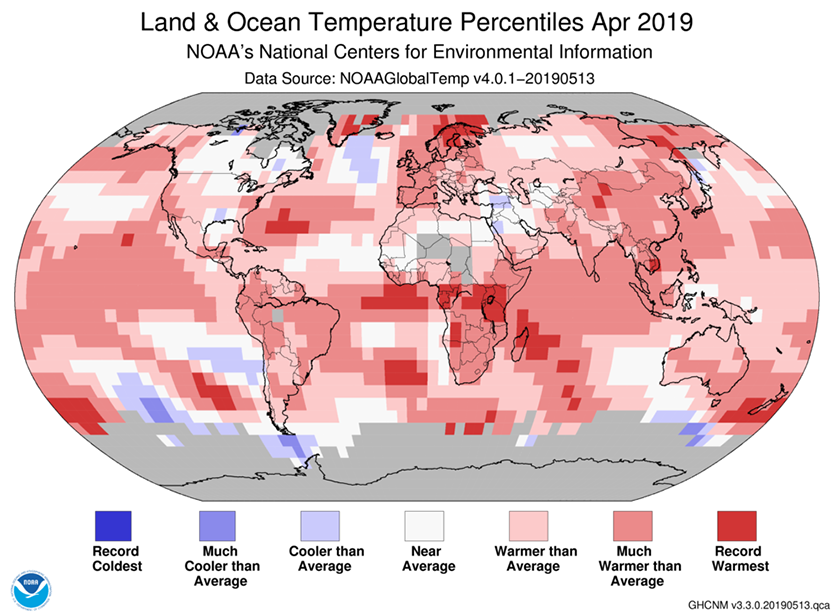
Figure 1. Departure of temperature from average for April 2019, the second warmest April for the globe since record keeping began in 1880, according to NOAA. Record warm April temperatures were present across parts of Asia, Greenland, Scandinavia, Barents Sea, central Africa, and the Atlantic, western Indian, and the south Pacific oceans. No land or ocean areas had record cold April temperatures. Image credit: National Centers for Environmental Information (NCEI).
No billion-dollar weather disasters in April 2019
No billion-dollar weather-related disasters hit the Earth last month, according to the April 2019 Catastrophe Report from insurance broker Aon. However, damage claims from a March 23 – 25 severe weather outbreak in the U.S. pushed above the $1 billion threshold by the end of April, giving Earth eight billion-dollar weather disasters so far in 2019:
- Flooding, Iran, 3/17 - 4/9, $8.3 billion, 77 killed
- Flooding, Midwest U.S., 3/12 - 3/28, $5 billion, 5 killed
- Flooding, Argentina, Uruguay, 1/1 - 1/20, $2.3 billion, 5 killed
- Tropical Cyclone Idai, 3/3 - 3/18, $2 billion, 1007 killed
- Flooding, Australia, 1/28 - 2/7, $1.75 billion, 3 killed
- Windstorm Eberhard, Central & Western Europe, 3/10, $1.5 billion, 2 killed
- Severe Weather, Central/Eastern U.S., 2/22 - 2/26, $1.35 billion, 4 killed
- Severe Weather, Plains, Midwest U.S., 3/23 – 3/25, $1.1 billion, 0 killed
The deadliest weather event of April was a storm system--known locally as a western disturbance—which spawned numerous clusters of thunderstorms across parts of Afghanistan, Pakistan, and northern India April 15-17, killing 146 people.
A weak El Niño event continues
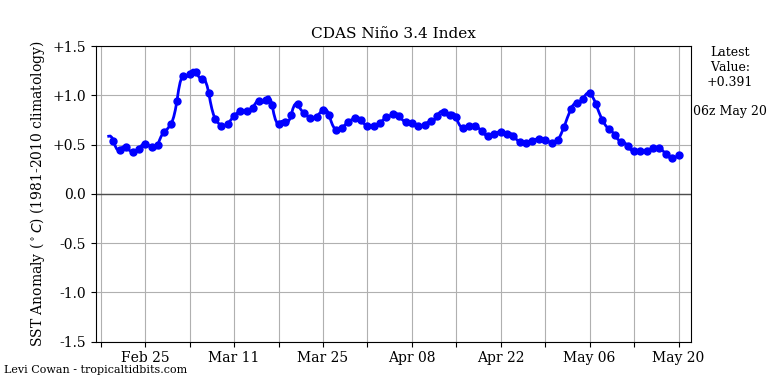
On May 9, NOAA continued its El Niño Advisory, initially issued in January. “El Nino is likely to continue through the Northern Hemisphere summer 2019 (70% chance) and fall (55 – 60% chance),” NOAA declared. These numbers are 5% higher than the probabilities from the April outlook.
SSTs in the Niño3.4 region—the one that’s most often used to diagnose El Niño and La Niña—must be at least 0.5°C above average for five overlapping three-month periods for an official El Niño event to be ordained. We have now had five such periods (September-November, October-December, November-January, December-February, January-March, and February-April), so the El Niño event of 2018-2019 is officially in the books. During April, SSTs in the Niño3.4 region were 0.6°C above average, just above the threshold for a weak Niño event, and the atmospheric response was typical of what we expect to see in a weak El Niño event.
Among the latest predictions from a large number of statistical and dynamical El Niño models for the peak of the Atlantic hurricane season in August-October, about 1/4 of the models called for neutral conditions, 3/4 called for El Niño conditions, and none predicted La Niña conditions. If El Niño conditions are present this fall, this would tend to favor a slower-than-usual Atlantic hurricane season due to an increase in the upper-level winds over the tropical Atlantic that can tear storms apart (higher vertical wind shear).
April Arctic sea ice extent the lowest on record
Arctic sea ice extent during April 2019 was the lowest in the 41-year satellite record, according to the National Snow and Ice Data Center (NSIDC), and was at record-low levels every day of the month. The previous low April extent occurred in 2016. However, springtime sea ice conditions are usually not a strong predictor of the summer ice cover because atmospheric circulation patterns in summer can flip; relatively cool and cloudy weather this summer would prevent a record-low summer for sea ice extent.
Antarctic sea ice extent during April 2019 was the second lowest in the 41-year satellite record, behind the record-low year of 2017.
Notable global heat and cold marks for April 2019
Hottest temperature in the Northern Hemisphere: 47.5°C (117.5°F) at Khargone, India, 28 April
Coldest temperature in the Northern Hemisphere: -48.0°C (-54.4°F) at Summit, Greenland, 2 April
Hottest temperature in the Southern Hemisphere: 43.3°C (109.9°F) at Mardie, Australia 7 April
Coldest temperature in the Southern Hemisphere: -77.4°C (-107.3°F) at Concordia Station, Antarctica, 29 April
(Courtesy of Maximiliano Herrera.)
Major weather stations that set (not tied) all-time heat or cold records in April 2019
Among global stations with a period of record of at least 40 years, 14 set new all-time heat records in April and 0 set all-time cold records.
Dolisie (Congo Brazzaville) max. 37.2°C, 1 April
Cabinda (Angola) max. 35.4°C, 2 April
Minna (Nigeria) max. 42.2°C, 4 April
Phuket (Thailand) max. 38.0°C, 10 April; beaten again on 20 April, with 39.2°C
Santa Rosa de Copan (Honduras) max. 35.6°C, 14 April
Ha Tinh (Vietnam) max. 40.3°C, 19 April
Huong Khe (Vietnam) max. 43.4°C, 20 April: New national record high for Vietnam
Kosumphisai (Thailand) max. 43.3°C, 20 April
Pathein (Myanmar) max. 41.8°C, 24 April
Toungoo (Myanmar) max. 44.5°C, 25 April
Pattani (Thailand) max. 38.9°C, 25 April
Bago (Myanmar) max. 42.2°C, 27 April
Catbalogan (Philippines) max. 37.5°C, 27 April
Cotabato (Philippines) max. 38.7°C, 28 April
Parbhani (India) max. 47.2°C, 28 April
(Courtesy of Maximiliano Herrera.)
Five all-time national/territorial heat records set or tied in 2019
Christmas Island (Australia), 31.6°C (88.9°F), 19 January
Reunion Islands (France), 37.0°C (98.6°F), 25 January
Angola, 41.6°C (106.9°F), 22 March
Togo, 43.5°C (110.3°F), 28 March (later tied on 4 April)
Vietnam, 43.4°C, (110.1°F ), 20 April
Additionally, all-time national records were probably set in Gabon, Congo, Uganda, the Ivory Coast, and possibly in Equatorial Guinea in March. In April and May, all-time national records were probably set in Chad, Cameroon, Gambia, Guinea, Ghana, Mali, Angola, Laos, and Guinea Bissau, but persistent data outages that affected the transmission of much of the data from non-industrialized nations this year have prevented data from being received from a number of nations that experienced unprecedented heat waves, according to Mr. Herrera.
No all-time national cold records have been set thus far in 2019. Most nations do not maintain official databases of extreme temperature records, so the national temperature records reported here are in many cases not official. I use as my source for international weather records researcher Maximiliano Herrera, one of the world's top climatologists, who maintains a comprehensive list of extreme temperature records for every nation in the world on his website. If you reproduce this list of extremes, please cite Maximiliano Herrera as the primary source of the weather records.
Forty-seven monthly national/territorial heat records beaten or tied in 2019
As of May 31:
January: Micronesia, Paraguay, Angola, Equatorial Guinea, Palau
February: Chile, Marshall Islands, Guyana, United Kingdom, Denmark, Sweden, Netherlands, Belgium, Luxembourg, Andorra, Austria, Hungary, Jersey, Guernsey, Slovakia, San Marino, Slovenia, Angola, Papua New Guinea
March: Australia, Marshall Islands, India, Kenya, Northern Marianas Islands
April: Angola, Togo, French Southern Territories, Mayotte, Taiwan, Kenya
May: Kenya, Indonesia, Niger, French Southern Territories, Syria, Tonga, Laos, Vietnam, Japan, Israel, Cyprus, Turkey
No monthly national cold records have been beaten or tied in 2019.
Hemispherical and continental temperature records in 2019
Highest minimum temperature ever recorded in the Southern Hemisphere: 35.9°C (96.6°F) at Noona, Australia, 18 January. The record was beaten again on 26 January, with a minimum temperature of 36.6°C (97.9°F) recorded at Borrona Downs, Australia. This is also the highest minimum temperature on record for the globe for the month of January.
Highest temperature ever recorded in the world in March: 48.1°C (118.6°F) on 10 March at Roebourne, Australia.
Highest temperature ever recorded in Asia in March: 46.9°C (116.4°F) at Kapde, India, 25 March. The data comes from a state (not central government) station, and may not be officially recognized, but is supported by data from several nearby stations.
The Weather Company’s primary journalistic mission is to report on breaking weather news, the environment and the importance of science to our lives. This story does not necessarily represent the position of our parent company, IBM.